
Merge Cells in Excel Without Losing Data — Columns, Rows, Duplicates & More in One Click
Excel’s built-in Merge & Center silently throws away every value except the top-left one. Try to combine three cells with First, Middle, Last and Excel keeps only First — pops up “Merging cells only keeps the upper-left value” and dumps the rest. Dose for Excel’s Merge tool does what users actually want: it concatenates values into one cell with your chosen separator, or merges entire rows or columns into a single field — across thousands of rows in one click. Nothing is lost. No CONCATENATE chains, no TEXTJOIN gymnastics, no helper columns.
Why Excel’s Built-In “Merge & Center” Loses Your Data
Anyone who has ever tried to merge two adjacent cells in Excel knows the dialog:
The web is full of workaround tutorials: write a =CONCATENATE(A1,” “,B1,” “,C1) formula in a helper column, copy-paste-values to lock the result, delete the originals, then manually copy the new value into the merged area. TEXTJOIN() (Excel 2019+) is slightly cleaner but still produces a helper column you have to clean up afterwards. Neither approach scales when you have thousands of rows of “First Name + Last Name” to combine, or a multi-column address you need to flatten into a single CSV field.
Dose for Excel’s Merge tool replaces the entire workflow. Pick the cells, choose how you want them joined (across rows, down columns, all-into-one, or auto-merge duplicates), type the separator, click Apply. The merged result lands in a new column or row in seconds. Original data preserved or cleared at your option. No helper columns. No formulas. No “data lost” surprises.
Key Features at a Glance
- Four merge modes in one tool: merge across columns (one new value per row), merge down rows (one new value per column), merge all selected cells into a single output, and auto-merge consecutive same-value cells in a column.
- Never loses data — every value in the selection is concatenated into the result with your chosen separator. Unlike Excel’s native Merge & Center, no value is silently discarded.
- Custom separator — choose anything: a space, a comma, a hyphen, a pipe, or a multi-character string like | or , . The same separator goes between every joined value.
- Clear original cells (optional) — tick the checkbox to wipe the source cells after merging so only the merged result remains; leave it off to keep the originals alongside the merged column.
- Auto-merge same-value cells — Dose walks down your selected column, finds runs of identical adjacent values, and visually merges them into a single cell — perfect for cleaning up summary reports where category or region labels repeat down the column.
- Backup Sheet safety net — tick one checkbox and Dose duplicates the current sheet before applying changes, so your original data lives one tab-click away.
- Bulk-range ready — runs on a single range, multiple non-contiguous selections, a whole column, or the entire worksheet. Live progress percentage on large operations, with ESC to cancel at any moment.
- Smart used-range detection — if you select an entire column or the whole sheet, Dose restricts the scan to cells that actually contain data, so even huge workbooks complete in seconds.
- Remember My Settings — Dose stores your last-used mode, separator, and toggles so the next run opens exactly where you left off. Reset to defaults is one click away.
- Available in multiple languages. Compatible with Excel 2010, 2013, 2016, 2019, 2021, 2024 and Microsoft 365 (32-bit and 64-bit).
How to Merge Cells in Excel (Step by Step)
- Select the cells, range, column, or rows you want to merge.
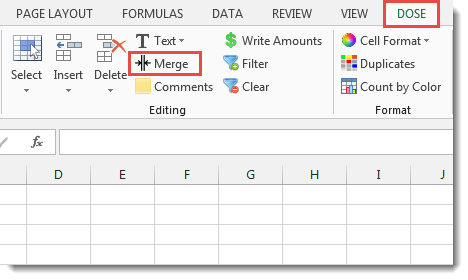
- Open the Dose tab on the Excel ribbon and click Merge.
- In the pane that opens, choose your mode: Merge values (with one of three sub-types: Columns, Rows, Cells into One) or Merge same values.
- Type your separator in the Text box (a space, a comma, anything you want).
- (Optional) Tick Clear contents to wipe the originals after merging, or Backup sheet to keep a safety copy.
- Click Merge. The progress indicator shows live percentage; press ESC any time you want to stop.

Merge Columns — One Row, Many Values Combined
Use Merge Columns when you have a wide table and want each row’s column values combined into one. Classic example: First Name + Middle Name + Last Name columns flattened into one Full Name column. The original three columns can be kept or cleared — your choice. The merged result lands in a brand-new column inserted immediately to the right of your selection.
In the example below we selected three adjacent columns of values, picked Merge values → Merge Columns, typed a comma , as the separator, then clicked Merge. The result on the right shows each row’s three column values combined with a comma between them, written into a new column on the right.



Merge Rows — One Column, Stacked Values Combined
Use Merge Rows when you have a tall column and want each column’s row values combined into one. Useful for flattening multi-row records into a single cell per column, or building a summary row that combines every value in each column. The merged result lands in a new row inserted immediately below your selection.
In the example below we selected a multi-row range, picked Merge values → Merge Rows, typed a comma plus space , as the separator, then clicked Merge. The result on the right shows a new row inserted below the selection where each column now contains every original row value joined with , .


Merge All Selected Cells into One
Use Merge Cells into One when you want every value in the selection concatenated into a single output cell — no matter how many rows or columns wide. Great for CSV preparation, building tag fields from scattered cells, or collapsing a small block of cells into a single header line.
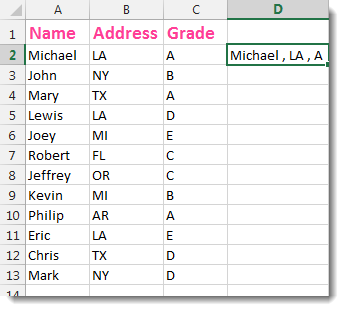
In the example below we selected a small block of cells, picked Merge values → Merge Cells into One, typed a comma , as the separator, then clicked Merge. The result on the right is a single cell (in a new column inserted to the right) containing every selected value joined with a comma between them.

Auto-Merge Same-Value Cells (Visual Merge for Duplicates)
This is the mode that cleans up reports. Pick Merge same values, select a column where some adjacent cells share the same value (typical: category, region, department, status — anywhere a label repeats down the rows), and Dose walks the column from top to bottom, finds every run of consecutive same values, and visually merges them into one tall cell.
In the example below we selected a column with repeating category labels, picked Merge same values, then clicked Merge. The result on the right shows each run of identical adjacent labels collapsed into a single visually-merged cell that spans all the rows where that value originally appeared.


Backup Sheet, Custom Separator & Clear-Contents Options
Merging is, by nature, an in-place transformation. Dose gives you three safety and customisation toggles right inside the pane:
Custom separator: the same character (or string) that goes between every joined value. Common choices: a single space for full names (John Smith), , for address lines, | for pipe-delimited exports, – for human-readable summaries, or even a multi-character string. Leave it blank to concatenate without any separator at all.
Clear contents: tick this to wipe the original cells after the merge so only the merged result remains in your sheet. Leave it unticked to keep the originals alongside the merged column — useful for double-checking the result before committing.
Remember My Settings: open the slide-out menu inside the pane and pick Remember My Settings — Dose stores your current mode, sub-mode, separator, and toggles so the next time you open Merge the pane opens exactly where you left off. Reset to defaults is right beside it if you want a clean slate.
Real-World Use Cases
- Full-name combination — merge separate First Name and Last Name columns into a single Full Name column with a space separator, in one click across thousands of rows.
- Address flattening — combine Street + City + State + ZIP columns into a single CSV-ready address field with comma-space separators.
- CSV / export preparation — merge multiple fields into a single delimited string when your destination system expects a flat record format.
- Pivot-summary cleanup — auto-merge repeated category, region, or department labels so a summary table reads cleanly without manual cell merging.
- Tag aggregation — merge a row of tag columns into a single comma-separated tags field for a content management system.
- Report-row consolidation — collapse multi-line entries into a single line for narrower printing or PDF export.
- De-duplicated visual reports — make repeating labels visually disappear by merging same-value runs into one tall cell per group.
Demo: Merge Cells in Excel in Action
Frequently Asked Questions
Does Dose lose my data when merging cells like Excel’s built-in Merge & Center does?
No. Dose’s Merge values mode concatenates every selected value into the result using your chosen separator — nothing is silently discarded. Unlike Excel’s native Merge & Center (which keeps only the upper-left value and pops up a “data lost” warning), Dose preserves every piece of text from your selection in the merged output.
Can I merge cells into one, merge across columns, or merge down rows?
Yes — all three. Pick Merge values, then choose: Merge Columns (each row’s values combined left-to-right into a new column), Merge Rows (each column’s values combined top-to-bottom into a new row), or Merge Cells into One (every selected value flattened into a single output cell). Each mode picks the right destination automatically — a new column to the right, a new row below, or a single cell.
What separator goes between merged values?
Whatever you type in the Text box. Common choices are a single space (for full names), comma-space “,” (for address fields and lists), pipe ” | ” (for delimited exports), or a multi-character string. Leave the box blank to concatenate values without any separator at all.
What is “merge same values” and when should I use it?
Merge same values walks down your selected column and finds runs of identical adjacent cells, then uses Excel’s native visual cell-merge to combine each run into a single tall cell. Perfect for cleaning up summary reports where category, region, or department labels repeat down many rows — one click turns the cluttered repeating labels into clean visually-merged groups.
Will the original cells be cleared after merging?
Only if you tick the Clear contents checkbox. Without it, the original cells are preserved alongside the new merged column or row — useful for double-checking the result before deciding whether to keep the originals. Tick Clear contents when you want the merged result to fully replace the source data.
Can I keep a copy of the original data before merging?
Yes — that’s exactly what the Backup Sheet checkbox is for. Tick it once and Dose duplicates the current sheet (with its data, formatting, and column widths) before applying any merge, so you always have a clean before-state on a separate tab.
Can I unmerge cells later?
For visually merged cells (the Merge same values mode), Excel’s standard Home → Merge & Center → Unmerge Cells command unmerges them. For concatenated values (the Merge values mode), the merged output is plain text in a new column — if you want to “unmerge” the joined string back into separate fields, use Dose’s Split tool to split the text by your original separator.
Which Excel versions are supported?
Dose for Excel works on Excel 2010, 2013, 2016, 2019, 2021, 2024 and Microsoft 365 — both 32-bit and 64-bit editions — on Windows. The interface is available in multiple languages.